01
PDE catalogue
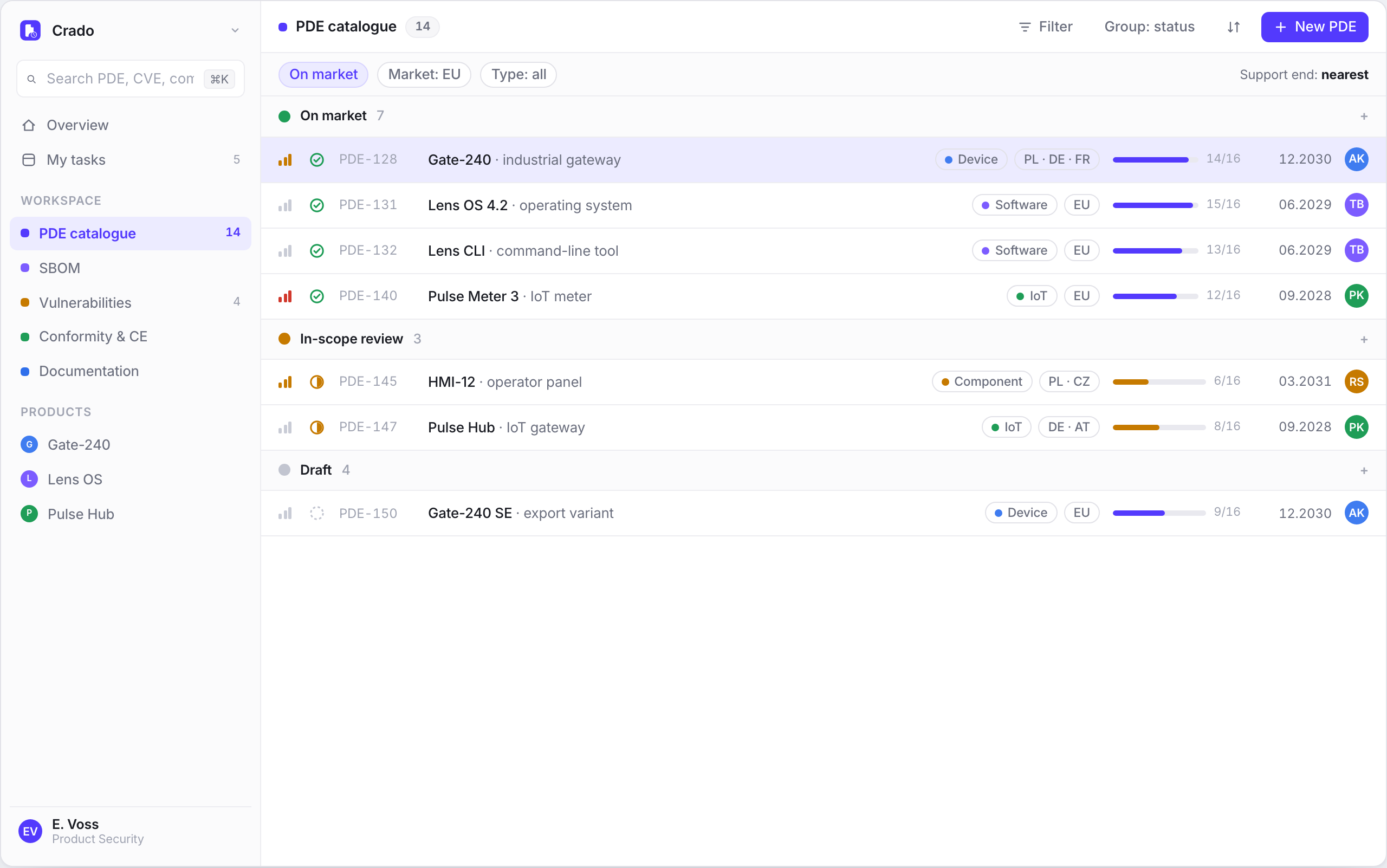
Products, versions, markets and placing-on-the-market dates. You see what CRA covers.
Cyber Resilience Act
Product map
Risk
SBOM
Documentation
On-premise
Product map, risk assessment, SBOM, documentation and vulnerability handling. One system, before the product reaches the Union market.
Scope
Vulnerabilities and the Article 14 clock are one module. The system runs the product map, risk assessment, SBOM, technical file and the CE path.
01
Products, versions, markets and placing-on-the-market dates. You see what CRA covers.
02
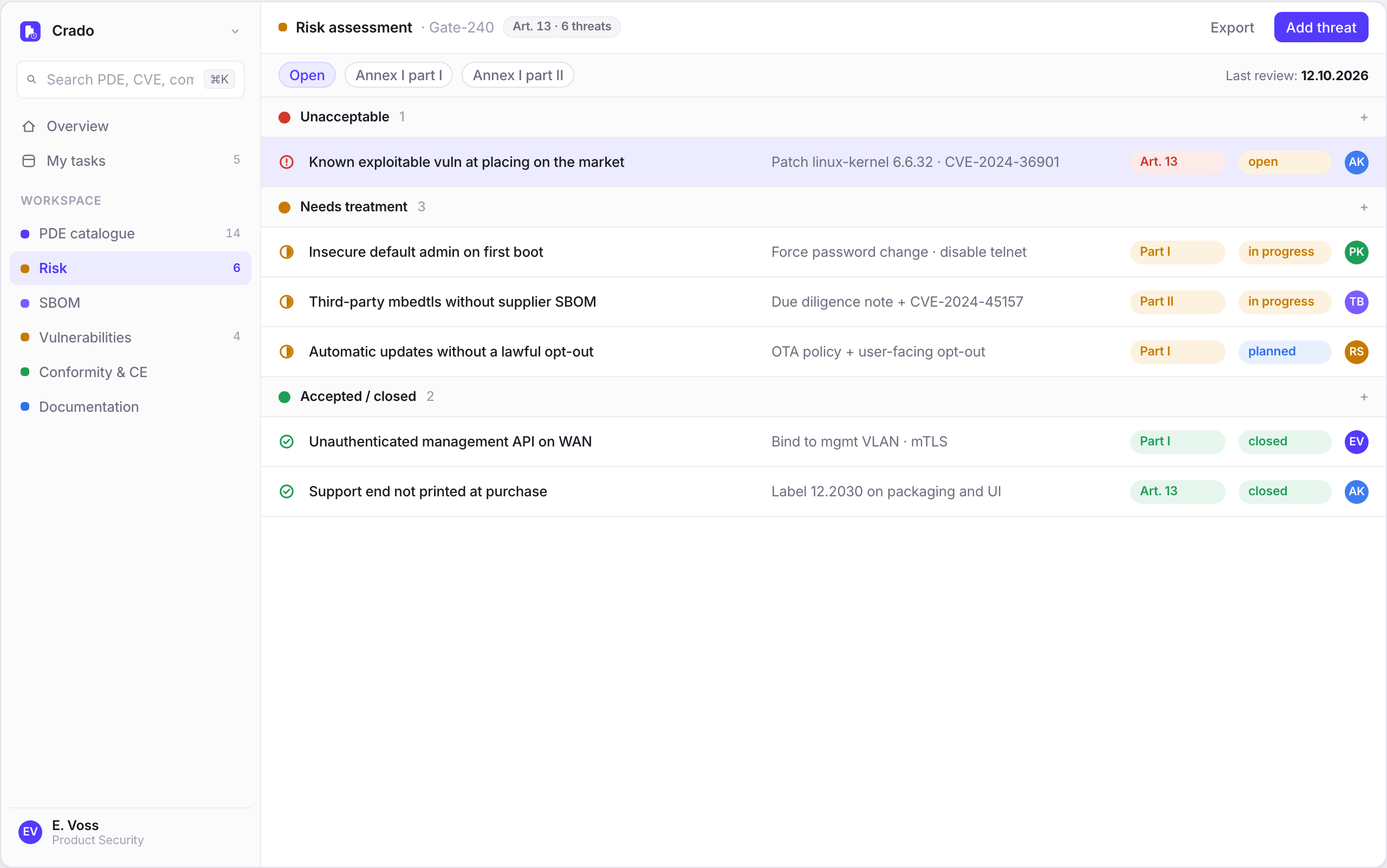
Essential requirements pinned to the product, with the risk assessment and gaps.
03
Ingredients, origin, licences and known vulnerabilities.
04
Handling through the declared support period, with a 24h / 72h clock.
05
A technical file ready if a market-surveillance authority asks.
06
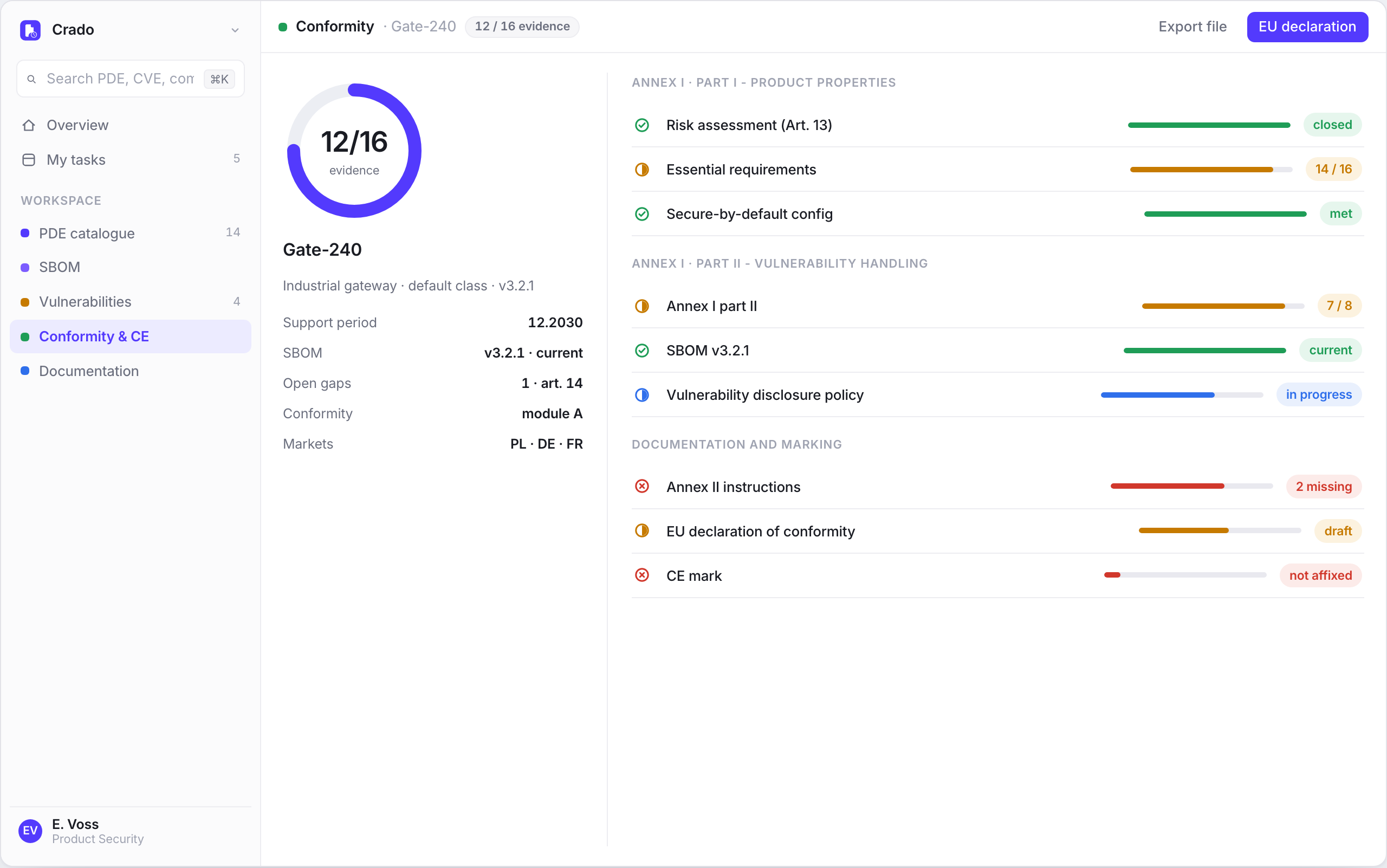
Conformity assessment, EU declaration and marking, before the product leaves the warehouse.
Products go in: name, version, type (device / software / component), markets, placing-on-the-market date, support end.
On each PDE you mark whether CRA applies, who the manufacturer is, and whether a substantial modification happened.
The risk assessment is tied to the essential requirements. A gap does not live in a side spreadsheet.
Components from CI or import, linked to CVE. Due diligence on the supplier stays on the component.
A vulnerability queue with a 24h/72h clock. Technical file, EU declaration, mark - before the product leaves the warehouse.
SBOM, risk assessment and the technical file stay on your network. There is no product cloud and we do not ask you to upload the file elsewhere.
Industries
Software
You do not need to ship a device to fall under CRA. An application, a library or an embedded system sold separately is a product with digital elements if you place it on the market under your name.
IoT
CRA wants no known exploitable vulnerability at launch, secure defaults, and updates through a declared period. That hurts more on firmware than on SaaS.
Industrial
A line, a PLC, an HMI, a gateway - if you place it on the Union market as a product, CRA asks about design, components and maintenance. Industrial buyers do not want that file in someone else’s cloud.
Electronics
Cybersecurity becomes a product property next to the older directives. The manufacturer needs a risk assessment, a bill of materials and a support period before the product is placed on the market.
Timeline
10 December 2024
The regulation is in force. Full application of the essential requirements comes later.
11 June 2026
The rules on notifying conformity-assessment bodies start to apply.
11 September 2026
Manufacturers notify actively exploited vulnerabilities and severe incidents: early warning in 24 hours, full notification in 72 hours, then a final report.
11 December 2027
A product placed on the market must meet Annex I, complete conformity assessment, carry an EU declaration and the CE mark. Risk assessment, documentation, SBOM and the support period must be maintained.
Knowledge base
Shortcuts to the key parts of the regulation and tools we are adding.
Product map, risk, documentation and the dates from the regulation.
10.2024 entry into force, 09.2026 Article 14, 12.2027 CE mark.
Essential requirements: product properties and vulnerability handling.
Manufacturer, importer, distributor, authorised representative.
Early warning 24h, full notification 72h, final report.
A checklist of essential requirements for the technical file.
Work out the support end and EOL date for a product.
No. Vulnerabilities and the Article 14 clock are one module. The system runs the product map (PDE), risk assessment and Annex I, SBOM, the technical file and the CE path.
Yes, if you place it on the Union market under your name or trademark. A PDE is not only a box of electronics.
Article 14 applies: actively exploited vulnerabilities and severe incidents. Early warning in 24 hours, full notification in 72 hours, then a final report. Through the single platform to the CSIRT of the main establishment and to ENISA.
Annex I essential requirements, conformity assessment, EU declaration and CE mark when placing on the market. Risk assessment, SBOM, documentation and the support period must already be running.
No. You install Crado AI on your site. The SBOM and the technical file do not land on our server.
No. The system collects evidence and runs the process. Conformity assessment stays yours.
From a handful of SKUs to a catalogue in the hundreds. On the call we ask how many PDEs you have and whether an SBOM already comes from the pipeline.
A fictional catalogue (Gate-240, Lens OS). It shows interface density, not a customer.
To hello@crado.eu. We reply to the address you give.